


General Insurance Blogs, Articles & Updates by - Magma Insurance
Have us call you
- RENEW YOUR POLICY
- BUY NEW POLICY

GENERAL INSURANCE BLOG

If you’re not confident in completing the 8 track on a two-wheeler, this guide is for you
Cleaning a driving test to obtain a two wheeler licence seems complicated, and the application procedure for a rider’s permit often dissuades many people from learning how to drive a two-wheeler. Balancing, control, awareness, and judgement are parameters evaluated during the practical assessment.
One of the most commonly feared parts of the test is manoeuvring the 8-track. It is the perfect test of all the criteria mentioned and requires excellent balance and coordination. Additionally, steering ability and break application are also checked in the test.
If making an 8-curve on your two-wheeler intimidates you, here are some simplified steps to ensure perfect results each time!
1. Pre-ride check:
Before starting, ensure your two-wheeler is fuelled and has appropriately functioning brakes and indicators. It is also necessary to practise with your helmet on to prepare yourself for the actual test, where it is compulsory to ride with your helmet on. Before starting, we recommend warming up by doing short laps in an open area to ensure you are correctly seated and find the right balance.
2. Initial right curve:
Usually, making an 8 begins by taking a right turn to form a quarter of the 8. You do not need to use the indicators in this section, so just focus on steering. Ride slowly up the arc and proceed towards the mid-point by following the lane markings to aid proper steering.
3. Prevent understeering:
The second quarter or the arc of the 8 can be easily manoeuvred by ensuring you do not understeer. Understeering occurs when the handlebar is turned at an angle less than the desired angle. Again, follow the markings to get a better judgement of the angle of steering. Maintain your momentum and balance while making the turn.
4. Reverse S-shaped curve:
After crossing one-half of the track, instead of sticking to the inner edge, slowly shift to the outer boundary of the curve to complete the reverse S arc. You might steer at a wider angle than required at this stage, resulting in your bike crossing the track boundary. This causes a failure in the test. So, be careful and ensure you have a strong grip on the handlebar.
5. Final curve before exiting:
The final curve is the easiest since it requires central positioning and basic balance before exiting the track by turning on your left indicator.
All you need to do is ensure coordination between the clutch, gear shifting, and accelerator while completing the 8-track. Remove the fear from your head, and understand that it is all about balance! Take a deep breath and get through.
Additional tips to make manoeuvring effortless.
For a rider with experience, the steps mentioned above may seem excessively detailed, but a beginner may require additional inputs to follow the same. Keeping these in mind can help prevent mistakes and make it easier to steer through continuous curves.
● Shift your weight slightly as you steer your bike to maintain your balance
● Do not go extremely slow, as it makes balancing difficult
● Ensure that you do not shift your handlebar to either end
● Keep your body relaxed and elbows at right angles to distribute weight evenly.
Beginners often question the need to learn how to make an 8-curve on their two-wheelers perfectly. Although such opportunities are rarely faced on the roads, they prepare one for sharp turns, immediate application of indicators, balance, and coordinated judgements. These skills are fundamental requirements of a good rider and prepare one for all terrains and roads. Before you begin practising your figure 8 manoeuvre skills, consider purchasing two wheeler insurance India which covers any accidents and allied costs you may face.
Click HERE to buy the best two wheeler insurance India.
Disclaimer: The information provided above is for illustrative purposes only. To get more details, please refer to policy wordings and prospectus before purchasing a policy.

How careful inspection can help you avoid falling for these age-old insurance traps
Insurance policies, including non-general and general insurance plans, have gained popularity among Indians. While the increased penetration rate is a welcome change, protecting policyholders against potential fraud becomes essential. Insurance companies are taking adequate measures to spread awareness and educate potential policy buyers about possible crimes that involve fake policies, fraudulent insurance agents, mis-sold policies, etc.
This blog informs you about insurance traps you might be prone to and helps you elude them.
1. False alerts: reviving expired policies –
One of the many ways scammers trap innocent people is by calling them about policies that lapsed a while back due to payment failure. These dormant policies are then illegally accessed by telemarketers, who call up policyholders, informing them of good news. According to them, policyholders can now get a bonus on their policy, but you can only access it with a fee. They may also try to sell new policies. You can easily avoid this trap by being vigilant and reading the fine print of your policy.
To prevent scams and fraud, IRDAI is also regulating the insurance sector by digitalising it. An e-Insurance Account is a digital portfolio of all your non-general and general insurance plans, which helps keep track of policy tenures, switch, or buy policies at a single click without any hassle.
2. A guaranteed return providing investment sans market volatility –
The lack of financial literacy is mainly to blame for this misconception. As the uninformed public continues to hear of the short-term successes of a small section of well-informed investors who do due diligence before making their financial decisions, they crave similar results without putting in as much effort.
Taking advantage of the situation, insurance agents often pitch general insurance plans as alternatives to conservative investments like a fixed deposit and promise high returns. While the money put towards any insurance policy is a better investment than letting it sit idle, such claims are not backed by proof and must be avoided.
3. Getting pitched insurance policies as a tax-saving investment –
Tax planning is usually seen as a dreadful task that most individuals undertake only when essential. Therefore, some folks jump at it when the most effective sales pitch comes in, saying that an additional insurance policy would give you tax cuts (because of 80C) and would be a suitable investment. The tax-saving months before March are when these fraudulent pitches are made, and people need to determine whether the investment is necessary in the first place.
As the insurance sector evolves, insurers must make policyholders aware of the role of general insurance plans as a protective cover rather than a mode of investment to minimise your tax burden.
Your overall financial and tax planning for the following period should be done at the beginning of the current financial year. It is crucial to consider all factors, including your current investments, non-general and general insurance plans you might have taken, your kid’s school fees, and other expenses. Start early, and you won’t be in a hurry to reach the deadline, so you can read the fine print on all the documents and do apt research before signing on anything.
Click HERE to learn more about general insurance plans.
Disclaimer: The information provided above is for illustrative purposes only. To get more details, please refer to policy wordings and prospectus before purchasing a policy.

Here’s how smart helmets are set to change the riding experience
Helmets are protective headgear that can save your life in case you fall from a running two-wheeler or collide with another vehicle. Also, wearing a helmet while riding a two-wheeler is compulsory under Section 129 of the Motor Vehicles Act, 1988.
Imagine if a helmet can detect drunk driving, location tracking, navigation, a hands-free device, and several other functions other than just protecting your head during a ride. Yes, this is all possible with the advent of intelligent helmets.
This article tells how smart helmets are set to change your riding experience.
1. Detecting a helmet:
Many two-wheeler riders do not wear a helmet intentionally. Also, some may forget to wear it while leaving home or the office. This can be dangerous to their lives in case they meet with an accident on their way. Smart helmets are equipped with Force Sensing Sensor (FSR) that detects whether the rider is wearing a helmet. It senses actual human touch. If it does not detect it, you will not be able to turn on the ignition of your two-wheeler.
2. Alcohol sensor:
Smart helmets can also be fitted with a gas sensor that can identify the alcohol content from your breath. It can be placed right in front of your mouth, detect if you are drunk, and prevent your vehicle from starting. This can be very helpful in avoiding an accident due to drunken driving.
3. Accident detection:
Smart helmets can detect accidents and alert a phone number by sending a message. It makes use of accelerometers and vibration sensors for this purpose. A free-fall sensing unit can detect when the two-wheeler falls freely and is not in control. Similarly, a vibration sensor senses signals and pressure and sends a message to the registered mobile number. This can be life-saving in times of an accident as the receiver of the message can instantly rush to the accident spot or alert friends, police, and an ambulance to reach the spot.
4. Over-speeding and rash driving alert:
Smart helmets can also alert you if you are riding above the speed limit fed into it or are driving rashly. Such alerts warn you to reduce your speed and drive carefully.
5. Bluetooth connectivity:
Smart helmets can be connected to your bike and mobile phone via Bluetooth. This can allow you to make calls or answer them safely while riding your two-wheeler.
6. Navigation, location tracking, and recording:
Smart helmets come equipped with a GPS device that can accurately tell the rider’s location. This can be useful in times of emergency or theft of your two-wheeler. Also, they can help in navigation while you are riding your two-wheeler.
You can also install hi-tech cameras on your smart helmets. They can record and store all the details of your rides, such as speed, distance covered, time taken, etc. This can be very helpful for bikers and racers.
Smart helmets are a world in itself, with numerous options for adding or removing applications and additional devices per rider needs. They can completely change how you have been riding your two-wheelers. They help to make your rides much safer and technologically advanced than a regular conventional helmet.
Why just rely upon a smart helmet to alert and protect you in case of an accident? Choose from a wide variety of 2 wheeler insurance online after comparing them thoroughly. Protect yourself from any sort of financial losses that you may suffer due to an accident or theft of your two-wheeler.
Click HERE to buy 2 wheeler insurance online.
Disclaimer: The information provided above is for illustrative purposes only. To get more details, please refer to policy wordings and prospectus before purchasing a policy.
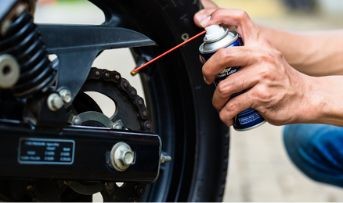
Here are some tips for maintaining your bike’s drive chain to ensure its longevity
A bike drive chain consists of interconnected oval loops made of metal, forming a roller chain. The teeth of a sprocket gear mesh with the holes in the links of the chain. The mechanical force from the engine puts the bike chain in motion, which causes the bike's wheels to rotate. Hence, a bike's drive chain is an important part and must be handled properly.
A drive chain is usually the dirtiest part of our bike. It is oiled and greased, catching loads of dust and mud from the roads. Here are some tips for maintaining your bike's drive chain to ensure longevity.
1. Periodic cleaning:
Regular cleaning keeps it free from dirt build-up, rust, and breakage. You should regularly check your drive chain by lifting the rear wheel of your bike off the ground and manually rotating the drive chain. You should check every chain link and use a firm brush to clean them.
If you hear squeaking sounds from the chain while riding your bike, it is time for relubrication. Also, you should check for tight links that are not bending easily. Clean them properly and lubricate them to ensure their free movement. It will also prevent rust build-up.
2. Lubricant quality:
Always use a good quality lubricant to ensure its longevity. It should be specifically made for a bike's drive chain and should not be just any lubricant.
Dirt and mud damage the drive chain. The lubricant should be such that it should minimise the accumulation of dust and grime on the drive chain. Also, it should be long-lasting as the drive chain will wear down and get damaged if the lubricant is less or missing.
3. Do not over-lubricate:
Over-lubrication is harmful to the drive chain. It will attract more dust, mud, and concrete from the roads and damage the drive chain. To ensure smooth operation, you should always wipe off excess lubricants with a rag.
4. Thorough cleaning of the drive chain:
In case you ride your bike through muddy roads frequently or use it on rough terrains such as a mountain, you should remove the chain completely when it becomes excessively dirty. You can remove it yourself or seek the help of a mechanic.
Use a good quality chain solvent available in the market and soak your chain in it for the prescribed time. Then scrub hard to remove the dirty grime from the chain links. The solvent will do its job, and your chain will become clean and grime-free. Relubricate your drive chain once completely dry, and put it back in the bike.
5. Stretched chains:
Sometimes your bike's drive chain seems to stretch and become loose. This is because of normal wear and tear of the chain with usage. A loose drive chain cannot provide a good grip for the movement of the wheels and may even slip from its cog.
Check for a loose drive chain regularly, and get it fixed as soon as you find one. Ignoring it may cause further damage to the drive chain, and you will have to replace it.
The drive chain of your bike is a very important part of its smooth running. You must take good care of the chain to keep it in its best shape. Clean it regularly and keep it sufficiently lubricated to ensure its longevity.
Buying a good bike insurance policy for your bike is another important thing that you need to do to ensure a glitch-free ride. Buy bike insurance online after comparing it with the policies of several companies. You can do this from the comfort of your home or office without physically visiting any insurance company. Go for the best bike insurance policy as per your specific needs and enjoy complete protection, security, and peace of mind.
Click HERE to buy bike insurance online.
Disclaimer: The information provided above is for illustrative purposes only. To get more details, please refer to policy wordings and prospectus before purchasing a policy.